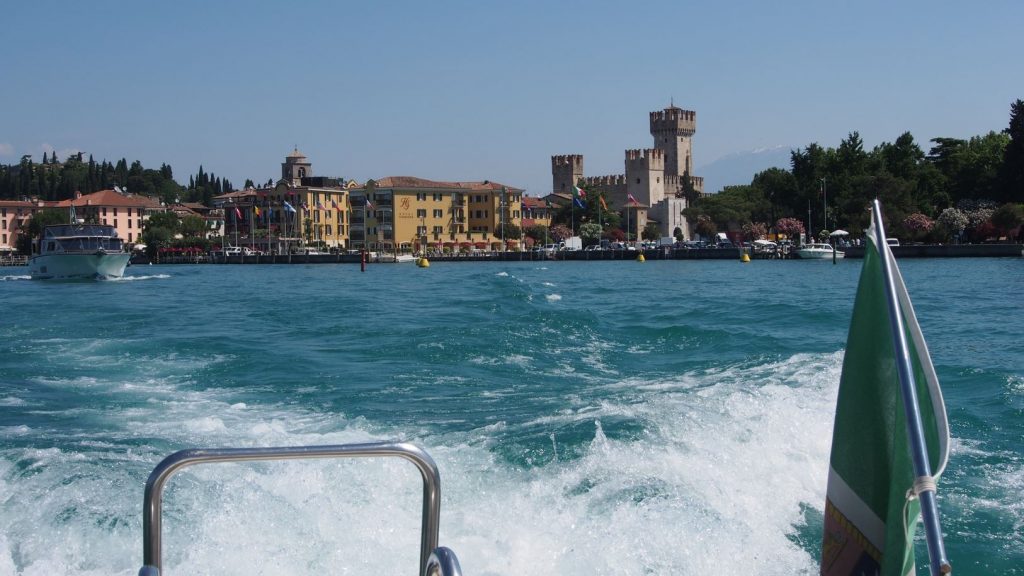
The key case study of SARLAKES is Lake Garda, Italy
«Suso in Italia bella giace un laco, a piè de l’Alpe che serra Lamagna sovra Tiralli, c’ha nome Benaco.» (Dante Alighieri, Inferno, Canto XX)
Lake Garda, known as Lago di Garda in Italian or lago Benaco, is the largest lake in Italy, situated in the northern part of the country. It stretches across three regions: Lombardy to the west, Veneto to the east, and Trentino-Alto Adige to the north. Its location at the edge of the Dolomite Mountains places it at the interface between the Alps and the Po Valley. It combines a large and relatively simple round-shaped geometry in the southern part with an elongated and narrow area surrounded by a steep orography in the northern trunk. It is occasionally subject to long-lasting storm winds, e.g. Foehn, leading to long fetch wave events.
Its unique environment results from a complex interplay of geological forces, climate, hydrology, and human history.
Overview
Lake Garda is approximately 52 kilometers long and 17 kilometers wide at its widest point, with a surface area of around 370 square kilometers. Its depth reaches up to 346 meters in the northern part near the town of Riva del Garda. The lake basin was formed by glacial activity during the last Ice Age, around 1.5 million years ago, when glaciers from the Alps carved out the valley that the lake now occupies.
It is primarily fed by the Sarca River, which enters at the northern end, and is drained by the Mincio River at the southern end, flowing out towards the Po River. The lake’s water is relatively clear with a visibility of several meters, and it has a mild temperature gradient due to its considerable depth and volume, allowing for thermal stratification.
The water temperature ranges from around 6°C in winter to 26°C in summer, fostering a diverse aquatic ecosystem.
Geological Formation and Evolution
The formation of Lake Garda is attributed to both glacial and tectonic activities. During the Pleistocene epoch, advancing glaciers sculpted the valley, while subsequent retreating glaciers left behind morainic deposits that partially blocked the valley, creating the natural dam that retains the lake’s water today. Ongoing erosion and sediment transport continue to subtly reshape the lake’s contours, making Garda not only a relic of the Ice Age but also a landscape still in evolution.
History and Cultural Heritage
Lake Garda has a rich and diverse history, with evidence of human settlement since Neolithic times. Over the millennia, the lake has been home to various civilizations, each leaving its mark on the region’s culture and development. Evidence from the Bronze Age includes remarkable pile‑dwellings (palafitte), now UNESCO World Heritage Sites.
The Winds of Lake Garda
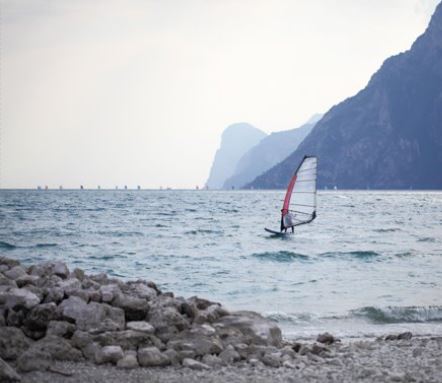
Wind systems are essential both for the lake’s microclimate and for its circulation dynamics. They also make Lake Garda a world-renowned location for sailing and windsurfing.
Ora: A predictable thermal wind from the south, blowing from midday to late afternoon—ideal for sailing and windsurfing.
Peler: A strong northerly wind active in the early morning; favored by experienced windsurfers.
Balinot: An easterly wind linked with storms and rapid weather changes.
Vinessa: A warm, humid southeast wind from the Adriatic bringing overcast skies.
Ponale: A moderate westerly breeze originating from the Ponale Valley.
These winds, shaped by the complex surrounding orography, drive the lake’s surface currents and vertical mixing processes.
Scientific Research and Environmental Monitoring
Understanding Lake Garda’s dynamics is crucial for preserving its water quality and ecological balance. Traditional scientific approaches rely on measurements of:
temperature
conductivity
chlorophyll
current velocity
water turbulence
Advanced models can support:
environmental management by local authorities;
ecosystem monitoring;
tourism services, such as predictive weather and wind apps for visitors and sports schools.
But growing tourism and agricultural runoff pose risks to the lake’s ecosystems. Lake Garda is much more than a scenic destination: it is a living laboratory for studying climate, hydrology, geology, and environmental change. Its blend of natural beauty, scientific relevance, and historical depth makes it one of Italy’s most extraordinary and loved landscapes.